
What is Wùo Taï?
Wùo Taï is a two-person body practice focused in particular on working with the fascia and their continuities.
What makes it distinctive is less the application of a sequence of techniques than a way of relating to the body: through movement, presence, listening and adaptation.
A practice that takes shape between two people
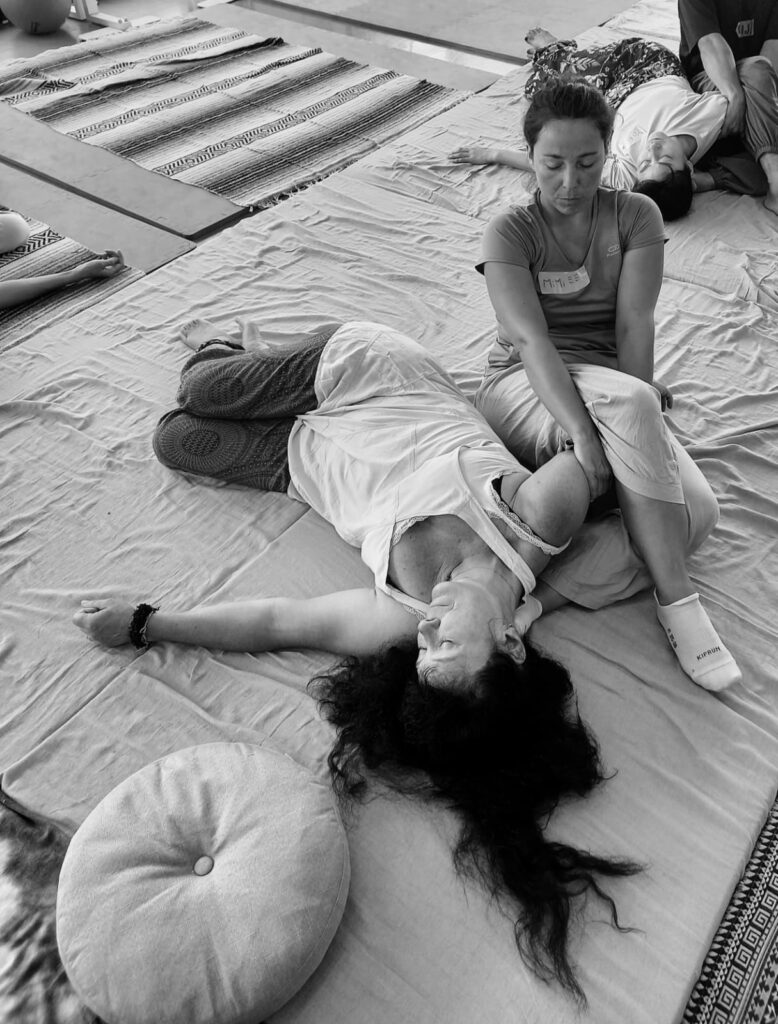
Wùo Taï is practised fully clothed, on the floor, on a table or seated. Floor work, particularly on a futon, is common. One person receives while the other guides, supports and moves the body.
The movement draws on suspension, a fixed point, appropriate tension, elasticity, release and micro-movement. This micro-movement can become unpredictable and tend towards the imperceptible. Rather than imposing a form, the aim is to accompany what emerges in the relationship.
Presence and precision take precedence over force. The movement adapts to the person, their limits and what is possible in the moment, without forcing or intrusion.
Fascia as continuity
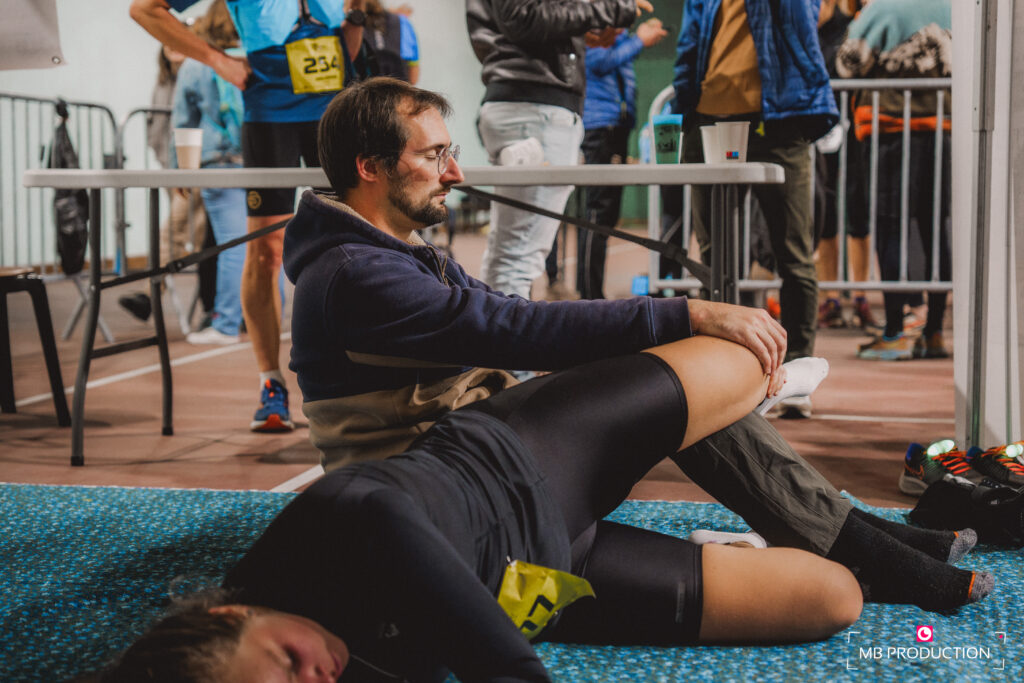
In Wùo Taï, fascia invites us to consider the body in terms of continuity.
It connects, separates and contains. One area can be mobilised without being isolated from the rest of the body. This way of reading the body shapes suspension, the application of tension and the way movement is guided.
“Turn your back on what you know,
what you want
and what you expect.”
A teaching cue that leaves more space for what emerges in the encounter.
Where does Wùo Taï come from?
Wùo Taï was created by Roland Combes, an osteopath and physiotherapist.
Its earliest developments date back to the early 2000s: Wùo Taï now spans more than two decades of practice, exploration and transmission.
It emerged from his clinical practice, through work with patients facing complex situations for which the tools available to him did not always prove sufficient. In searching for new responses, Roland developed movements from which a distinctive logic and coherence gradually emerged.
Its development drew on the breadth of his background: osteopathy, embryology, Qi Gong, yoga, relaxation, massage and the I Ching.
Nathalie Combes then played a structuring role in its teaching and organisation, enabling Wùo Taï to move beyond the clinical setting and be passed on to other practitioners and teachers.
Receiving and practising: two experiences of Wùo Taï
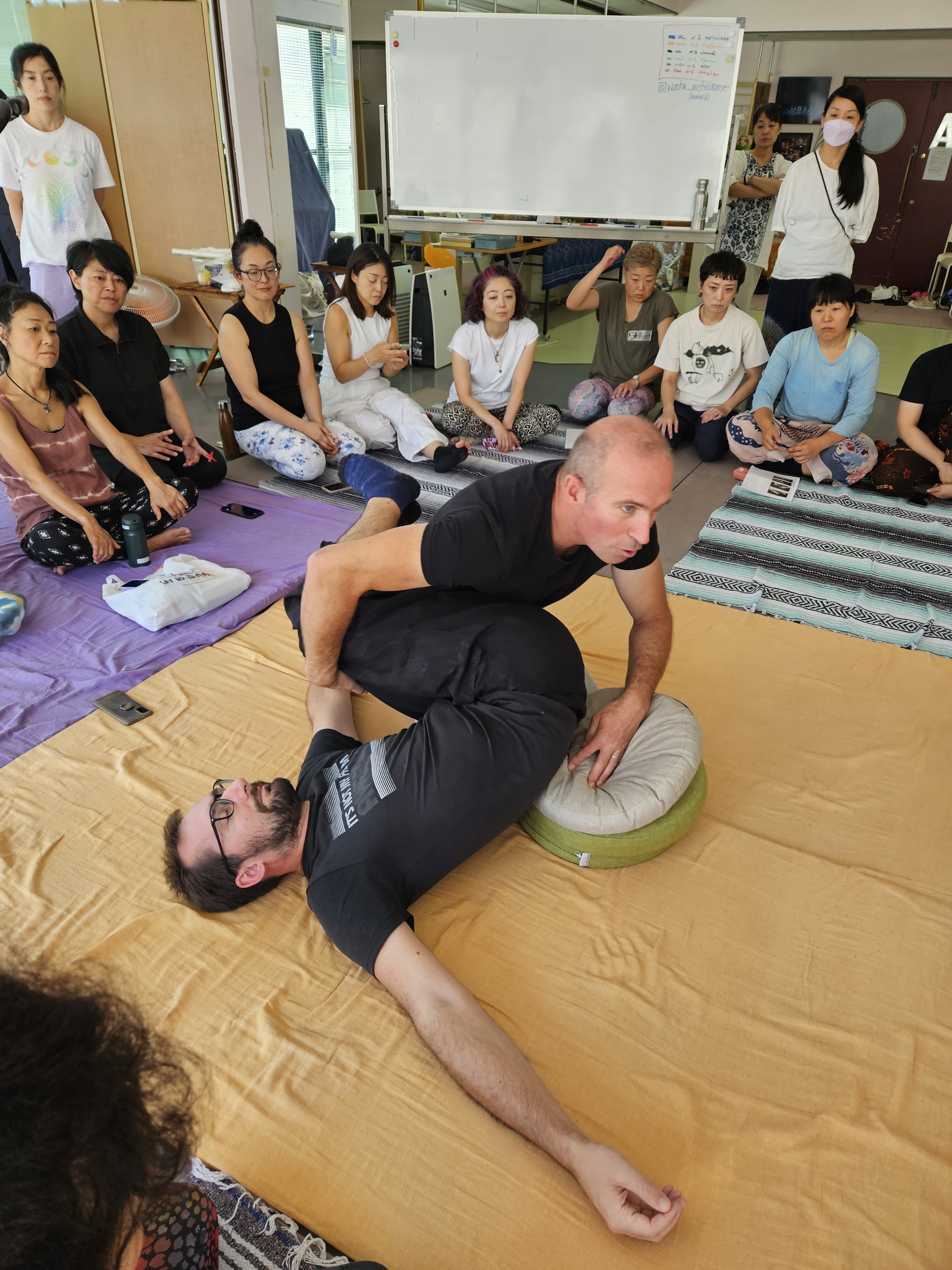
Wùo Taï is experienced from both sides of the relationship. Receiving and practising offer two different experiences, both grounded in presence, listening and adaptation.
Receiving
Experience non-intrusive contact that adapts to the body rather than trying to constrain it.
The movement can be firm and responsive while remaining gentle and enveloping. It respects the limits and possibilities of the moment, without seeking to impose a response.
Practising
Develop a different quality of touch, presence and listening.
The person guiding observes and adjusts their posture, suspension and movement. They learn to adapt to what emerges rather than mechanically reproducing a response planned in advance.
Wùo Taï is discovered through experience
Words can offer points of reference.
But Wùo Taï is understood above all through practice.
Our training programmes allow you to discover the practice, then deepen it progressively through experience.