
Train in Wùo Taï
Learn through experience, understand through the body
Training in Wùo Taï is not about learning a sequence of movements to reproduce. It means gradually entering into a two-person practice, developing clear reference points, experimenting with movements, receiving them, observing them, and then learning to adapt them to the person and the situation.
See. Understand. Experience. Practise. Then reconnect the movements into a continuous whole.
“The body as a space for encounter”
A two-year training programme
The main Wùo Taï training programme unfolds over two years, each organised around three modules and a validation stage.
Articular · Myofascia · Visceral · Validation
Fascia · Osteo · Energetic · Validation
The three modules within the same year can be taken in any order.
Year One must, however, be validated before beginning Year Two.
Six modules, six areas of exploration
Each module opens a different way into the body and the practice. As the training progresses, reference points become more refined, exploration deepens and the practice gradually becomes more precise. The aim is not to accumulate isolated techniques, but to build a bodily vocabulary that can then be brought back into continuity.
YEAR 1 — Discover
Articular
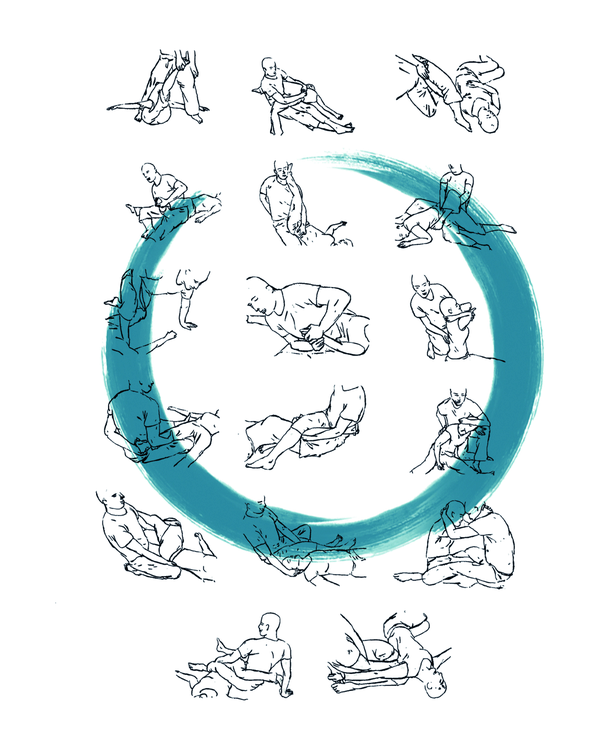
Explore the joints and everything organised around their connections.
Explore the joints of the body and everything organised around them.
The module covers in particular the lower and upper limbs, the spine and the sacral region. Attention is not limited to the joint itself, but extends to the connections, attachment points, fascia and different passages around it.
The aim is to learn how to mobilise this environment and perceive the relationships between its different elements.
Myofascia
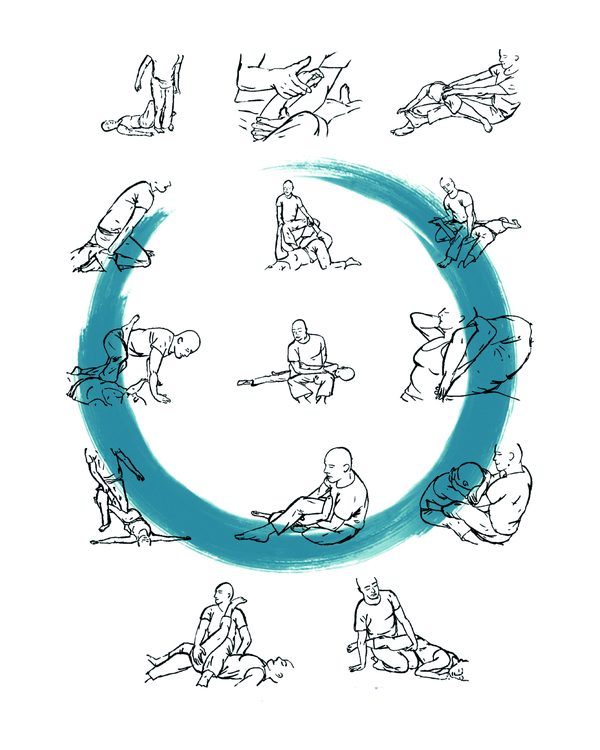
Enter more deeply into muscular structures and develop the experience of suspension.
Explore the fascia that surround and organise the muscles, from large muscle groups to more specific muscles or muscle groups.
This module continues the discovery of Wùo Taï through slow, experimental work. It develops suspension in particular: creating a fixed point, progressively bringing the structure into tension, then learning to move and gently “dance” within that tension.
Muscular anatomical reference points help refine the exploration and reveal how a muscular structure is organised, relates to the rest of the body and contributes to overall mobility.
Visceral
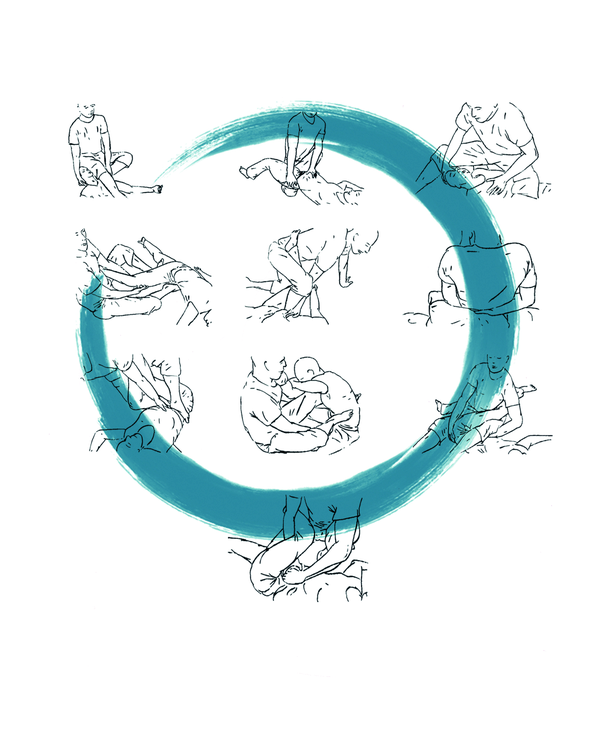
Explore the body more deeply and discover the relationships that organise the viscera.
Explore the fascia surrounding the organs and understand how each organ sits within a network of relationships with the rest of the body.
This module marks a deeper entry into exploring the body. Anatomy plays an important role: locating the organs, their fascial envelopes, attachments and relationships with the vertebrae, ribs and neighbouring structures. These reference points are then used to build precise levers for working through connective tissue.
The practice retains the Wùo Taï principles of suspension, listening and mobilisation, with one particular emphasis: learning to give more of your body weight.
The Visceral module offers a finer understanding of the interconnection between different structures in the body and a deeper experience of embodiment.
YEAR 2 — Deepen
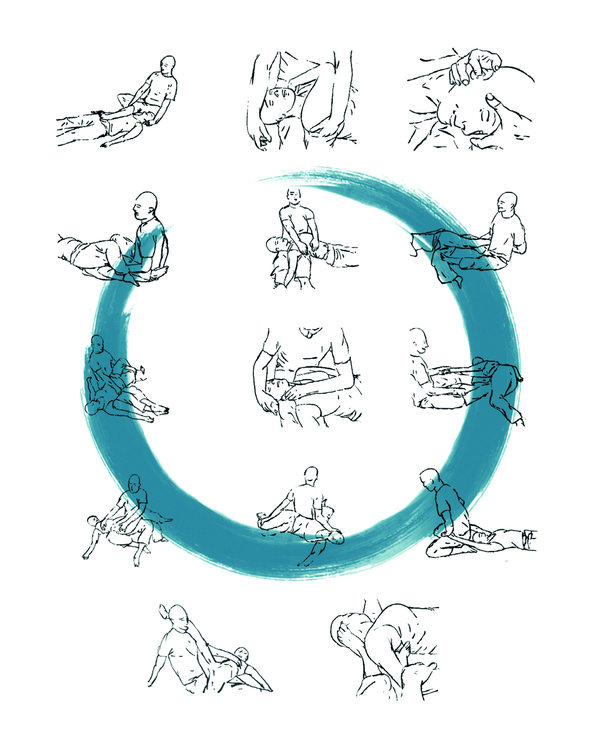
Fascia
Explore the major fascial continuities with increasingly precise anatomical reference points.
Explore the major fascial continuities of the body with increasingly precise anatomical reference points.
The work includes twisting postures, leverage systems and suspension involving both the upper and lower body.
Depending on the continuity being explored, different fixed points help organise tension and refine perception of the pathway being worked with.
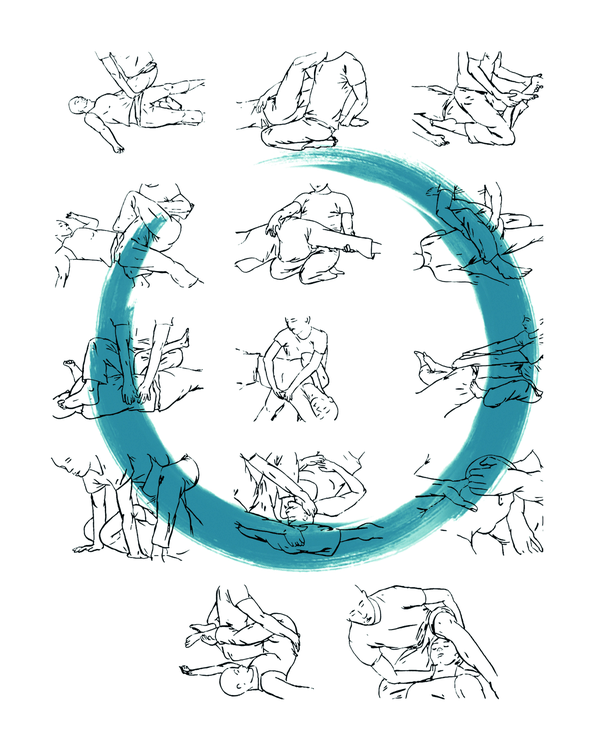
Osteo
Deepen joint work with greater precision, safety and rigour.
Deepen joint work with greater precision, safety and understanding of the situations encountered.
Inspired by an osteopathic approach, this module gives an important place to anatomy, vertebral landmarks, precautions and adapting movement to the person’s context. It develops a clearer understanding of what can be mobilised, what requires greater care, and how to adjust posture and leverage.
The work becomes more specific and precise: movements are refined, reference points strengthened and safety takes a central place.
The Osteo module marks a genuine step up within the training programme, towards a more demanding, rigorous and professional practice.
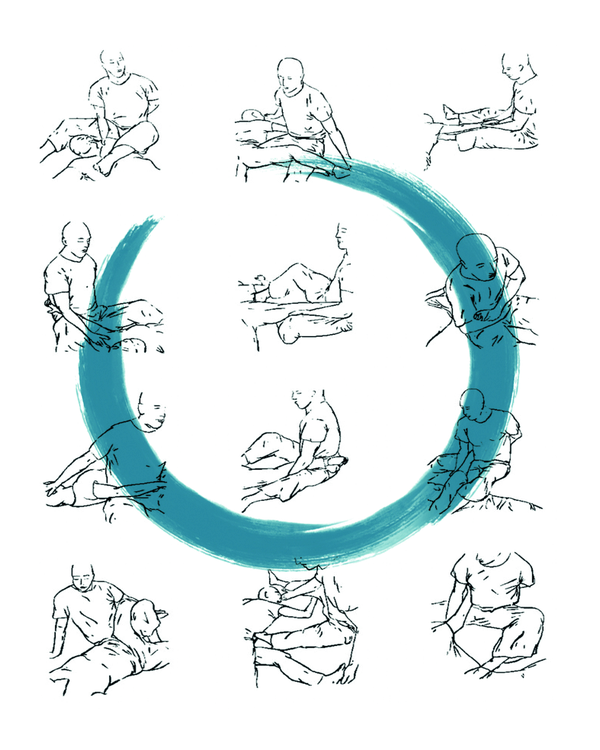
Energetics
Follow selected meridian pathways and develop another quality of listening and felt experience.
Explore selected meridian pathways used in Wùo Taï and develop another quality of listening.
Here, the emphasis is particularly on felt experience and observation: noticing what changes and what appears in the experience and the relationship, without trying to impose or force a correction.
Training through different points of view
Giving
Build your reference points, positioning, suspension and ability to adapt.
Receiving
Feel the movement directly and notice what it brings forth in your own body.
Observing
See what unfolds in the relationship between two bodies and gradually refine your perception.
This alternation is an integral part of learning. A movement is first shown as a whole, then revisited, broken down and experienced before being brought back into continuity.
Return to continuity
Movements studied separately take on their full meaning when they are brought back into an overall flow.
A continuous sequence performed by Myriam and Simon will show how movements studied separately can reconnect into a complete movement.
Video in preparation.
Complete flow of a module
Learning to adapt rather than apply a protocol
Wùo Taï is not about mechanically reproducing the same form for everyone.
The training develops sufficiently precise reference points to then listen to the person, their body, their limits and what is possible in the moment.
The movement can be firm while remaining gentle and enveloping. Force is not used as a way of obtaining a response from the body.
Learning therefore involves both acquiring movements and developing a quality of presence, listening and adaptation.
Validation stages
Each year ends with a period of review, deepening and validation of the three modules studied.
The days leading up to the assessment allow each module to be revisited. During the validation stage, movements are selected from those studied during the year, with preparation time provided.
The aim is to check how well the practice and its reference points have been integrated throughout the training.
Join or host a training
Would you like to join an upcoming module, continue your training programme or organise a training at your centre?
Myriam and Simon can answer your questions about the programme and explore with you the possibilities for hosting a training.