
Teaching Wùo Taï together
We discovered and learned Wùo Taï during the same period, with Roland and Nathalie. We followed the training programme together, practised extensively between training sessions, then continued learning through assistant roles and teaching experiences.
But we did not arrive there by the same path.
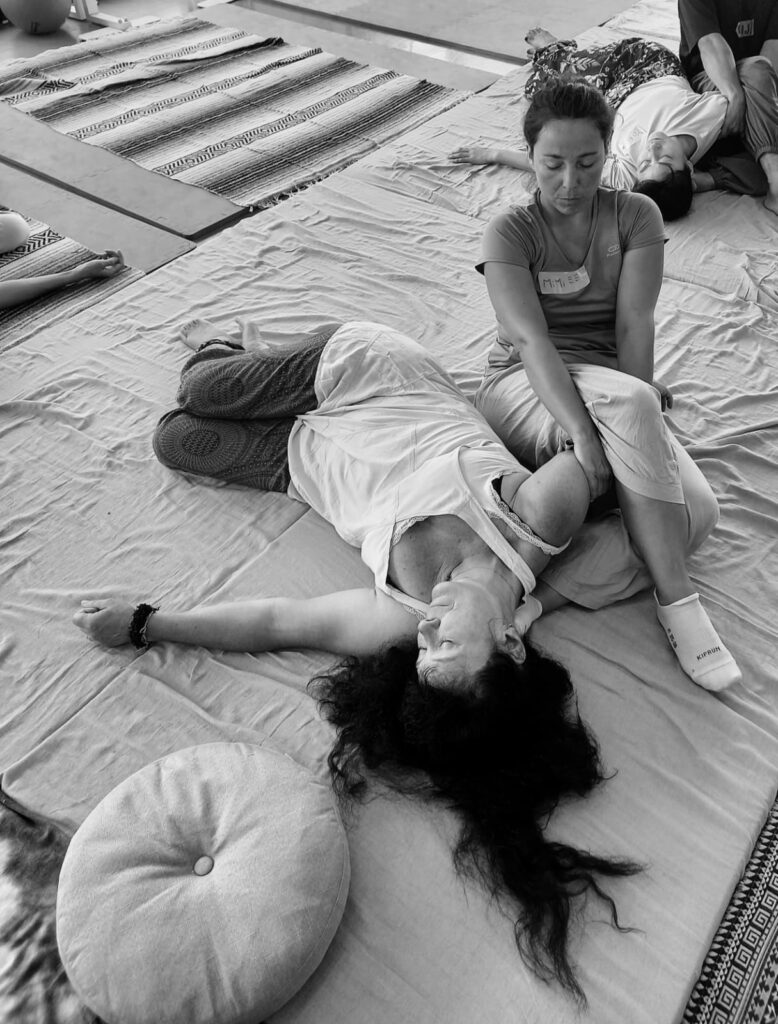
Two paths, one shared approach to teaching
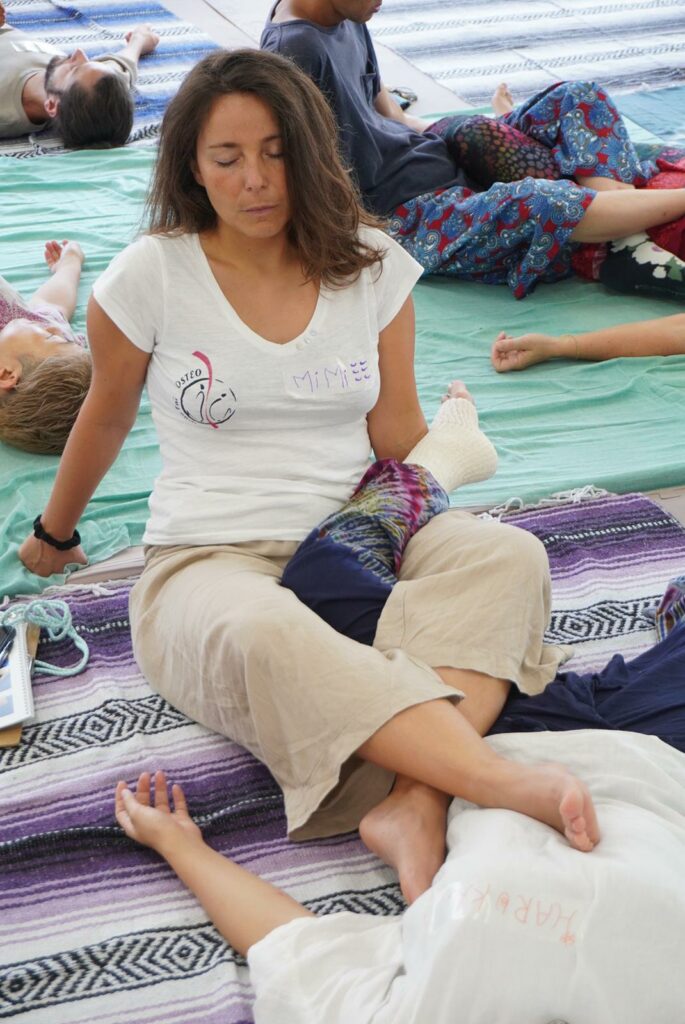
Myriam
Precision, safety and attention to the body.
Before Wùo Taï, Myriam worked as a hospital nurse for around fifteen years. Wùo Taï accompanied an important shift in her professional path: gradually leaving the hospital environment to work as a home-care nurse, while also developing other body-based approaches, including reflexology.
This professional experience directly informs the way she teaches. Myriam pays particular attention to anatomy, precision of movement, language, safety and each participant’s comfort.
She observes closely: tension, hesitation, a facial expression, a position becoming uncomfortable. She works to create a framework in which participants can practise, ask questions and adjust their movement with confidence.
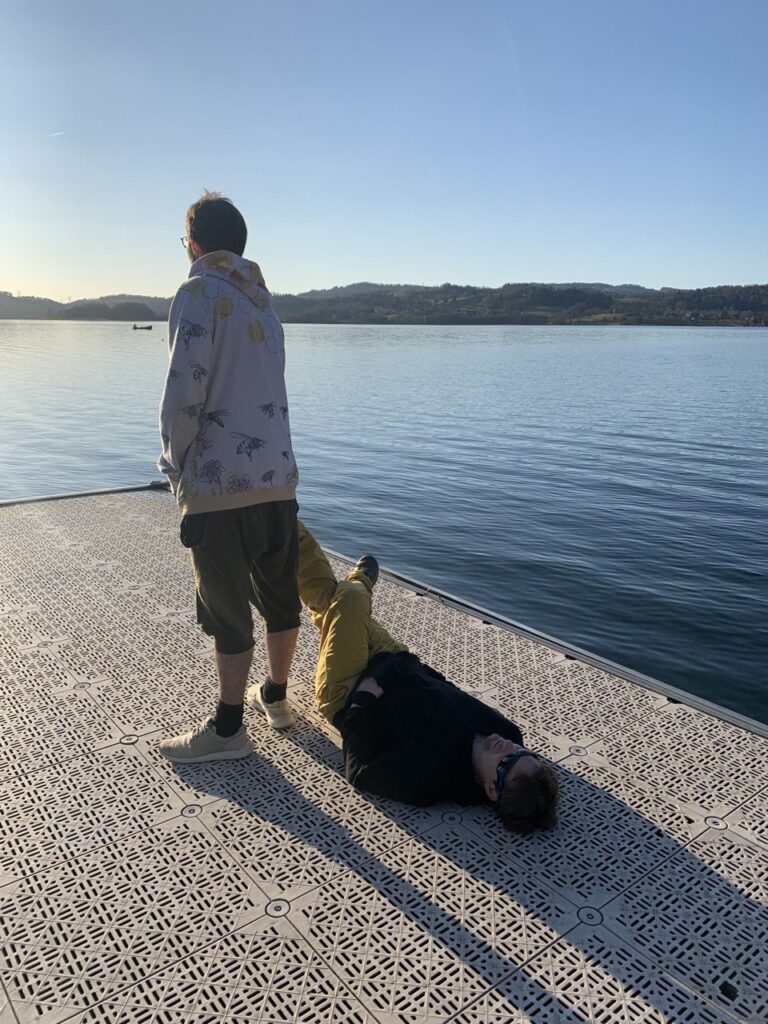
Simon
Felt sense, experimentation and a philosophy of movement.
Simon’s path was shaped in a less academic way, through travel, introspection, meditation, body-based experimentation and personal work around the relationship with the body and oneself.
His work later became professional in private practice, notably as a traditional manual practitioner (rebouteux), before Wùo Taï gradually became one of his main tools in practice.
In teaching, Simon places felt experience at the centre. Understanding a movement is not just knowing how to perform it: you need to be able to perceive its quality, sense what changes and understand what you are trying to create in the relationship.
He also brings a broader, more philosophical reading of the practice: why this movement? what quality of presence? what relationship with the other person? how can we remain available to what emerges rather than mechanically reproducing a technique?
Two sensibilities in dialogue
We do not each try to teach our own part.
We can both demonstrate, explain, observe and support the practice. But our different sensibilities lead us to notice different things.
Where one of us may emphasise precision, safety or an anatomical landmark, the other may draw attention to a sensation, an intention or the overall quality of the movement.
This double perspective also allows us to question one another. Teaching together makes us compare our perceptions, clarify what we want to pass on and keep learning ourselves.
Japan, a pivotal experience
Among the experiences that particularly shaped the way we teach, our work as assistants to Roland and Nathalie in Japan holds an important place.
We supported large groups together in a different cultural and linguistic context, taking on genuine teaching responsibility while remaining within the framework led by Roland and Nathalie.
This experience required us to observe more, simplify our explanations, adapt quickly and, above all, truly work as a pair.
It confirmed something that was already there: we wanted to teach Wùo Taï together.
Why teach as a pair?
Wùo Taï itself is a practice for two. Teaching it as a pair allows us to demonstrate a movement together, observe the group from several angles at the same time and be more available to participants.
But our choice goes beyond that practical advantage.
We trust each other’s perspective. We know we can question one another, correct each other, not always notice the same things and still move in the same direction.
It is this complementarity — between precision and felt experience, structure and experimentation, anatomy and lived experience — that we now bring to our teaching.
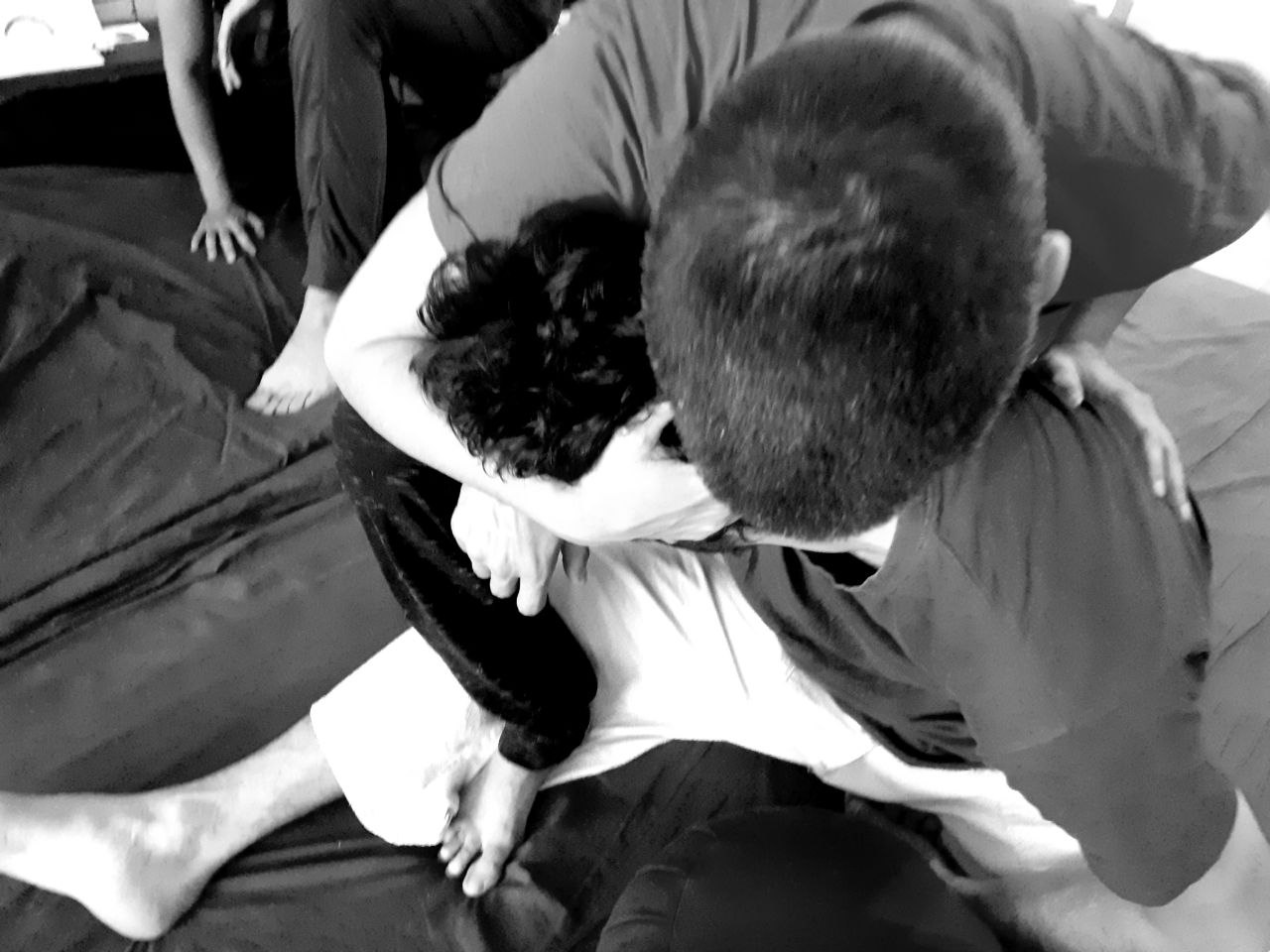
A teaching approach that leaves room for experience
We favour highly experiential learning: short demonstrations, clear reference points and plenty of time devoted to practice.
Learning alternates between giving, receiving and observing, with individual feedback and constant adaptation to the person and the situation.
Practising
Understanding Wùo Taï begins in the body. Explanations support the experience; they do not replace it.
Observing
Watching, feeling and receiving are as much part of learning as performing the movement.
Adjusting
The aim is not to reproduce a protocol mechanically, but to integrate principles so that the movement can be adapted to what emerges.
Discover Wùo Taï through experience
Our way of teaching finds its full meaning in practice.
You can join a training to discover or deepen your Wùo Taï practice, or host a training at your venue.